Media Kit
You Don’t Need A Reason.
Lessons from a Barstool.
Release date: September 4, 2026
One Barstool. One Comment. One Book.
You can have the career. The house. The money. The passport. The freedom.
So why do so many women still hesitate before eating alone in a restaurant, taking the trip, speaking their mind, saying no, or doing something simply because they want to? Because somewhere along the way, we learned that freedom came with rules.
At seventy, Angel Cicerone thought she was free—until one seat at a New York City bar and one social media comment made her question everything. What began as going out alone became a funny, surprising, sometimes uncomfortable exploration of the invisible rules women inherit and carry long after they've supposedly been set free. The rules that tell us to be Present. Useful. Chosen. The rules that make us ask: Is this allowed? Is this selfish? What will people think? Do I need a reason?
With sharp humor, personal stories, and hard-earned wisdom, You Don't Need a Reason is a permission slip to stop performing your life and start participating in it. You don't have to become someone new. You might simply need to meet the woman you've been all along.
You don't need a reason.
You never did.
-
CHAPTER 1
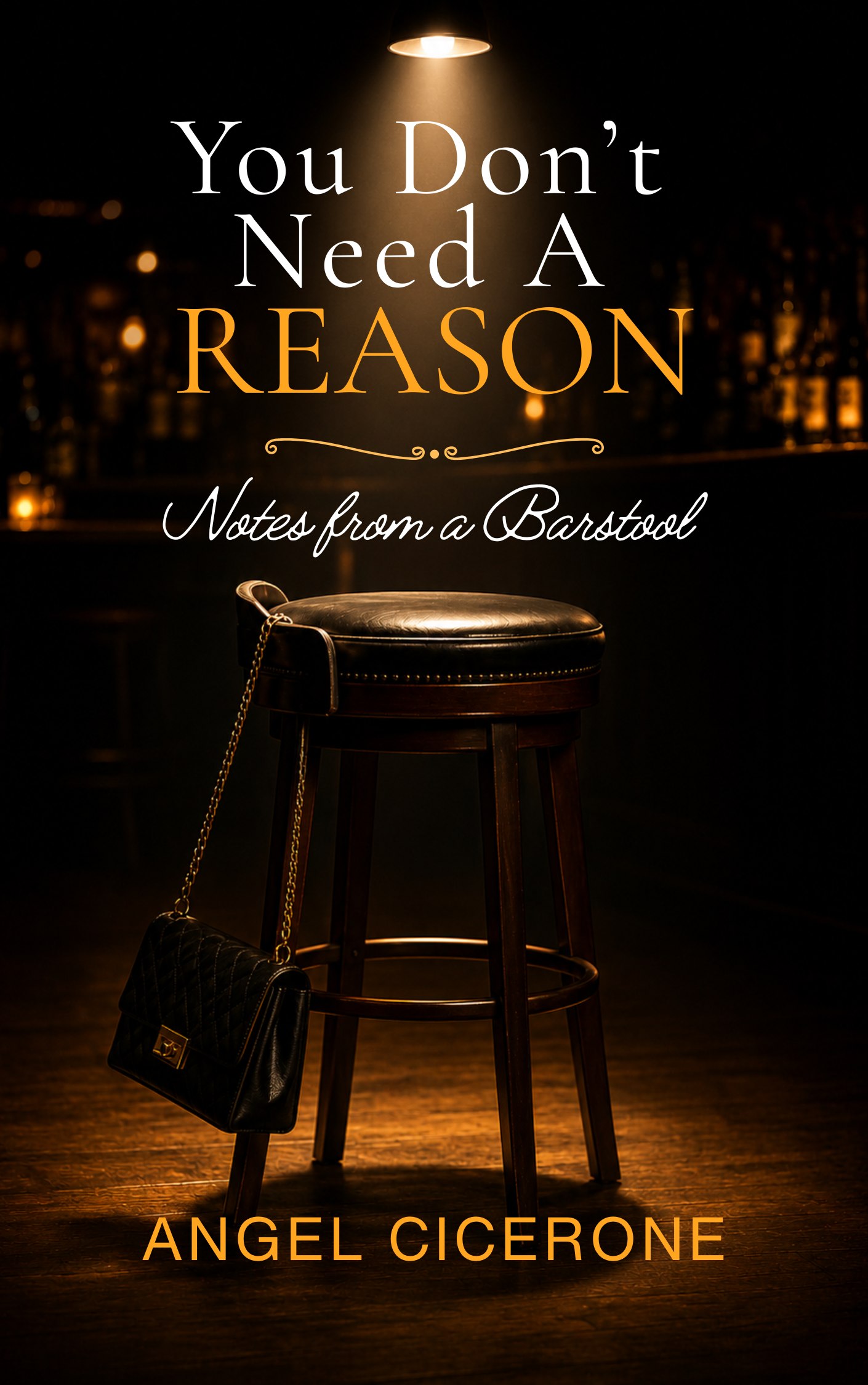
THE WOMAN ON THE BARSTOOLI am sitting at a bar.
Alone.
On purpose.No one is waiting for me.
I am not waiting for anyone.I did not come here to be discovered, rescued, admired or chosen.
I came because I felt like leaving the house. That’s it.
No birthday.
No date.
No celebration.
No man.
No mission.Just a woman, a stool and a perfectly decent glass of wine. And apparently, for many people, this is shocking.
Women write to me to say they could never do this. They would need a reason.
A friend in town.
A work thing.
A husband running late.A story that makes their presence acceptable. Otherwise, why would a woman be out in the world?
Here’s the answer that seems to rattle people to the core. Because she wants to be.
I am 70 years old and I have finally run out of interest in explaining myself.
I grew up believing we were the progressive ones. We had jobs. Opinions. Bank accounts. Shoulder pads that could cut through glass ceilings.
We thought we had escaped the cage. Turns out that cage was just a newer model.
Be pleasant.
Be desirable.
Be useful.
Be chosen.Even our freedom had a purpose.
Go out, but not alone.
Talk, but make it mean something.
Be attractive, but God forbid you attract attention.
Be independent but end up partnered.
Have fun — but please let it lead somewhere respectable.I am tired.
Not tired of living.
I am wildly interested in living.I am tired of the requirement that every moment must justify its existence.
Somewhere we picked up the idea that joy must justify itself. That presence must lead somewhere. That if we are visible, pleasant, open, dressed, out in the world — it must be in service of an outcome.
A relationship.
A business connection. A story.
A future.
But what if a moment could simply be lovely and then be over? What if a conversation could just be a conversation?
What if going out meant you went home as exactly the same person — except you had lived a little?
What if you don’t need a reason?
As I sit on this barstool, I am not making a statement. I am not representing womankind.
I am not conducting research. I am not proving bravery.
I am having a Tuesday.
And if that sounds radical, then something has gone very wrong with how we’ve taught women to exist.
This book is about that.
It is about being visible without being available. It is about conversation without contracts.
It is about showing up for your life even when there is no prize at the end. Especially then.
I am done with explanations.
Here is the only one I have left: I wanted to be here.
And that is reason enough.
-
Angel Cicerone is a 70-year-old author, entrepreneur and marketing executive who has spent decades building her own businesses and others’ and helping companies understand what makes people pay attention. She has never been particularly interested in doing things the expected way. At 60, she moved to New York City and began building an entirely new chapter of her life.
Then a seemingly ordinary social media comment sent her down a rabbit hole. She began noticing how often women restrict themselves without recognizing those restrictions: waiting for the right time, worrying about what others will think, needing a good reason, or quietly deciding they "can't." And she realized she was doing some of it, too.
That discovery became You Don't Need a Reason, a funny, candid exploration of the invisible rules women absorb—and what happens when they finally stop asking permission.
-
1. I'm 70—and I Didn't Realize I Was Still Asking Permission
How accomplished, independent women can still unconsciously edit their choices around what other people might think.
Talking points: permission culture, self-imposed restrictions, people-pleasing, the difference between choosing and complying.
2. One Barstool, One Comment, One Book
The unlikely story of how a social media comment sent Cicerone down a rabbit hole and completely changed the book she thought she was going to write.
Talking points: the original comment, the observations that followed, discovering the idea of "permission," and why the barstool became the metaphor.
3. The Invisible Rules Women Don't Realize They're Following
Nobody hands women a rulebook. Yet somehow many of us know exactly what we're "supposed" to do.
Talking points: being useful, being agreeable, taking up space, spending money, traveling alone, starting over, saying no, and the fear of disappointing people.
4. What Happens When You Stop Postponing Yourself?
Why women can spend decades waiting for the right time—and what can happen when they decide there doesn't have to be one.
Talking points: starting over at 60, doing things alone, choosing curiosity over convention, and why "someday" is often just another form of permission-seeking.
5. Why 70 Might Be the Most Interesting Age Yet
Getting older isn't the end of becoming someone. In many ways, it's the first time you can stop performing for everyone else.
Talking points: reinvention after 50, what gets better with age, letting go of other people's expectations, staying curious, and why women aren't finished becoming interesting.